An Ill Wind Blew
Labels: Cemetary
Sons and daughters of Jewish Przemysl, researching and remembering 700 years of Jewish life in our town
Labels: Cemetary
Labels: Cemetary

Labels: Cemetary
Hello David,
I owe you some stories on Przemysl. The last question about Manns deserves an answer. Fasten your belt, I'll take you and Kenny on a ride.
"His sister's name was Clara, I believe.", writes Kenny. Klara died in 1941 and her tombstone is among not so many (ca. 750 out of thousands) that survived.
The sentence on the plaque of Klara's tomb reads: "To my mum who taught me to be eternally young. Son."
What's more, we have a story about her funeral, written by her granddaughter. This is a piece:
“I’m on Slowackiego Street. A little higher up is the Jewish cemetery, where my grandmother was buried during the winter. I think back to her wretched funeral: that little coffin on the rickety cart, Mother and I following behind. I go to the cemetery. […] It’s quiet and peaceful in the cemetery. Fat insects crawl over the grass. The old stone grave markers tell the histories of former families. The gold letters of the shining sepulchres call to those who have gone and assure them of the impeccably good taste of those who have remained. My grandmother’s grave is off to the side. In the beaten clay a black marker has been stuck. ‘Klara Mann, born… died 12 XII 1941’... a beginning and an end. I stand by my grandmother’s grave but I do not cry. I am not thinking any more of her lonely death. She loved me so much. In my thoughts I beg her to help me rescue my parents and my brother.”
Sounds familiar? Yes, this is a part of memoirs I uploaded at ARC website years ago.
Aleksandra Mandel was the daughter of Salomea Mandel (born Mann), Klara's daughter, and Aleksander Mandel. She was the only survivor. She later changed her first name to Cecylia. Diminutive of Cecylia is Cesia (pron. Tsesha) and it must be "someone known as Aunt Tseckia", as Kenny writes. Kenny may not remember that Cesia visited them in Africa, sometime in 60's. This visit was foreseen in prophetical conversation in Przemysl ghetto, moments before it's liquidation started:
"‘To turn my Mother’s sad thoughts to other things – my Mother, who is so bravely bearing the burden of our poverty – I hug and kiss her, and talk to her about my uncle, who from far, from Africa, writes to us through Switzerland and who will certainly help us as soon as the war finishes.
“And you, Mama, will be the first great lady of Africa, and Tata and Jozio will eat bananas for breakfast and pineapples for dinner.”
Mama looks around at our shabby little room, at the lamentably empty cupboard, at the unlit stove, and says: “Child, you might see it, but my grave will be growing grass by then…”
And next passage:
“The Gestapo bang on our window.
“We’re coming,” says Tata, “Here you are, my watch, it will stay with you.” He puts the old watch that was his father’s down on the buffet.
“Think that you were with us on a ship during a wreck, and we went down, while a life buoy brought you to shore...”
“Uncle will ask you to Africa after the war,” Mother adds.
Here is the most disinterested, sublime love in the world. Even now my parents don’t think of themselves.”
After the war Aleksandra/Cesia lived in one of Galician towns and worked as a journalist, like her father. She wrote an article about her african trip which is remembered there.
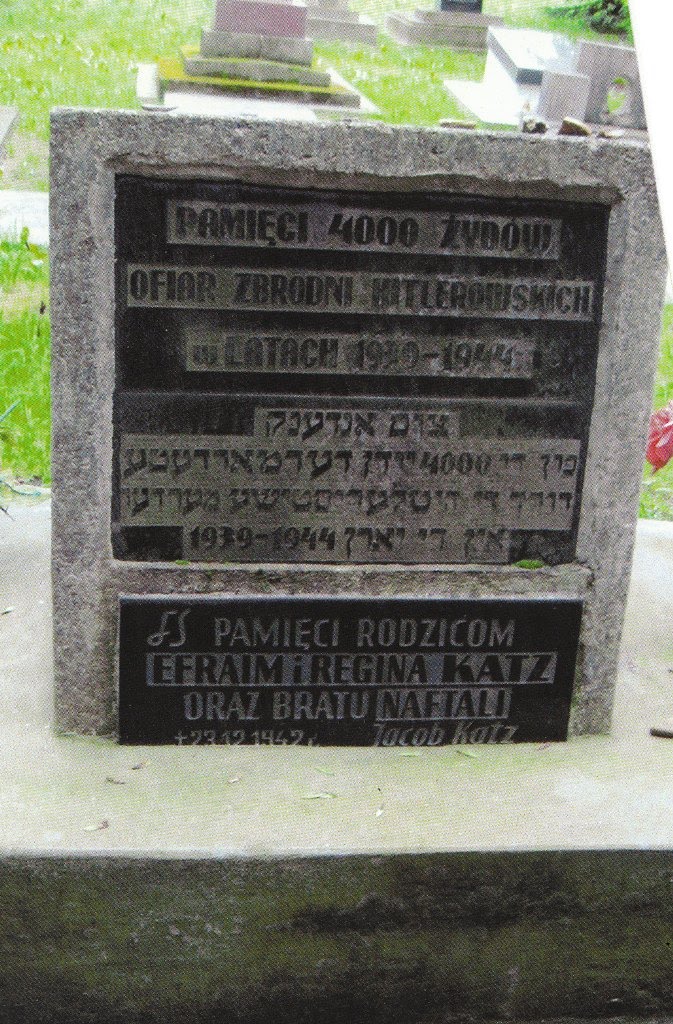
She and her husband founded an obelisk at Przemysl cemetery commemorating her parents and her brother.
The rest is also true - her son Oles and a grandson Maciek are well known photographers indeed, now in Krakow.
Aleksandra deposited her memories in 1946 at Jewish Historical Commission in Krakow. They are kept at Jewish Historical Institute in Warsaw now.
I wish you, all your family, and Kenny too, sweet and peaceful New Year.
And Gmar Hatima Tova.
Lukasz
Once a year I take a break from blogging family remembrances and ask everyone who is interested in saving what little is physically left of Jewish Przemysl to join me and Dr. John Hartman in raising money for the effort. Labels: Cemetary
The Jerusalem Post, February 23, 2010
Polish city returns medieval cemetery to Jewish community
By Michael Freund
Przemysl, Poland - After years of negotiations, a centuries-old Jewish burial ground in southeastern Poland that was desecrated by the Germans during the Holocaust has been restored to the Jewish community.
The cemetery, located in the city of Przemysl, near Poland's border with the Ukraine, dates back to the 16th century and served local Jews as well as those in nearby towns such as Jaroslav, Pruchnik, Kanczuga and Dynow for hundreds of years.
But the Przemysl municipality, which took over the site following the end of World War II, resisted calls to return it.
At a meeting last week, however, Poland's government-backed Regulatory Commission, which resolves claims regarding Jewish communal property, instructed city officials to turn the cemetery over to Jewish control.
The decision marks a triumph for the Warsaw-based Foundation for the Preservation of Jewish Heritage in Poland, and especially for its president, Monika Krawczyk, who led the effort in recent years to recover the graveyard.
Krawczyk, whose foundation is responsible for safeguarding thousands of Jewish cultural, historical and religious sites throughout Poland, expressed satisfaction at the news.
“We are happy that the Przemysl cemetery was returned to Jewish hands," she told the Jerusalem Post, noting that, "its history is so important and intriguing".
Known as the "old cemetery", the Przemysl burial ground was in use for nearly 300 years until it became full in the middle of the 19th-century, prompting the Jewish community to open a second one in the area.
Sitting on two hectares (20 dunams), the "old cemetery" had graves dating back to at least 1574 (5335 on the Hebrew calendar).
But after the Germans invaded Poland in 1939 and occupied Przemysl, they vandalized and despoiled the site.
Prior to the Holocaust, the city was home to an estimated 20,000 Jews, who constituted nearly 30% of the city's population. Most of them were murdered by the Germans and their collaborators.
"The ancient tombstones in the cemetery were used by the Germans during the war to pave local roads, and until now, we have not succeeded in tracing them," Krawczyk said. "After the war, the brick wall surrounding it was demolished, and the materials were used by neighbors to repair local buildings."
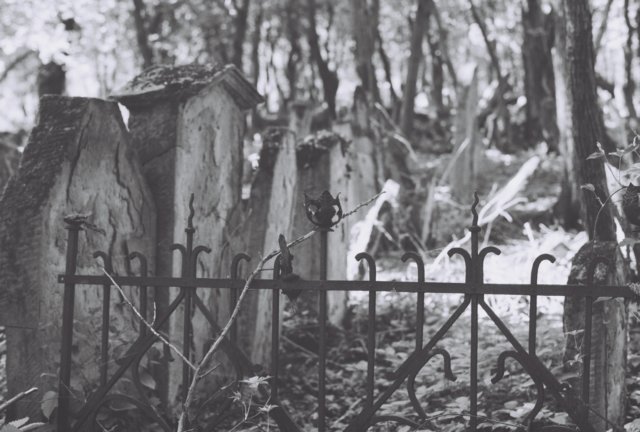
No graves are currently visible on the site, which is overrun by weeds and vegetation and badly in need of renovation. The only trace left standing is one of the entrance gates to the cemetery.
Krawczyk, whose group will be responsible for restoring and administering the site, said that the first priority will be to take steps to prevent its further deterioration.
"We need to start with securing the perimeter of the cemetery and building a fence to protect it,” she said. The foundation has already commissioned a technical team to prepare a design.
Krawczyk expressed the hope that Jews from abroad will assist with the refurbishment of the cemetery grounds.
“We have to remember that we do it for the past generations who contributed so much to our people and our culture, and we do it also for future generations," she said.
"The least we can do for those who were buried in the old Przemysl cemetery is to try and restore the dignity of their final resting place," she added.
Over the past decade, The Remembrance & Reconciliation Foundation (R&R), led by Dr John Hartman, has taken the lead in the restoration and maintenance of the Slowackiego Street Cemetery in Przemysl. Anyone who has been to the site ten years ago and recently can testify as to the progress - and the amount of work that remains.
We are lucky to employ one of the very few Jews left in the town, Mr. Jocaim Glettner, a mason by trade, as the general contractor/overseer. Paying him, and just keeping up with maintenance usually costs $5,000/year – but over $8,000 this year as the dollar tanked.Labels: Cemetary
John, founder of the Remembrance and Reconciliation Foundation, has overseen the restoration and maintenance of the Jewish Cemetery. He reports:The cemetery sustained some winter damage due to a big wind storm and the unusually harsh winter conditions. The city helped out a bit but we will need to spend some money by the summer. The original holocaust memorial is eroding and needs repair.Repairs are not cheep, particularly with the current euro-dollar exchange rate. Just keeping up with the weathering this year will run in excess of $5,000. But it's raise the money or watch this sacred place crumble before our eyes and soon be forgotten.

Labels: Cemetary, Rozia Felner

In our October 2005 visit, with the help of a good Polish friend, and the good memory of my mother, who lives in Rechovot Israel, we were able to find the house she was born in Slowackiego 47, where my grandfather Avraham Schwartz had a tobacco and liqueur store.Where, no doubt, my grandfather bought cigarettes...
The cemetery is on the same street and the lot between it and the Catholic cemetery belonged to my grandfather, who used the money to move the ENTIRE family to Haifa in 1937.Thank Ha-shem for that!
The communal grave of the 102 Nazi victims from 1939 is on the edge of my grandfather land lot. My Grandmother Batia Yahre Schwartz is buried there (died around 1931/2) and my mother remembers that she was placed in area No. 6 of the cemetery.Does anyone know or have a map of the cemetery layout?
We visited the Scheinbach synagogue, on the same street, and it is in great condition as a public library. My grandfather was the Ba'al Kore, before he left for Palestine.Baal Kore is the Torah reader
We found at Koleyova 5 (the train street) the 5 story building that my uncle, Shemuel Schwarz, the architect, had built and lived on the top floor. We also found the photo studio of my uncle, on Slowackiego, just as it gets to the downtown. He was active in the Temple synagogue.Anyone know what became of this school?
We could not find my mother's school: Hebrisca Schola Co-Edcatzina on Ulicia Gurna (the hill street).
[Here are] pictures of Boruch Myers (Chief rabbi of Bratislava) and Michael Schudrich (Chief rabbi of Poland) reciting Przemysl Slicha at Jewish cemetery in Przemysl. For the first time since the war and the probably last time ever. Autumn 2006.
Photos by Jacek Szwic


Complete English translation of the Slicha here.
Labels: Cemetary, Photos, Rozia Felner, Synagogues
Though not Przemysl specific, there is some interesting stuff at The Museum of Family History web site. In addition to excellent narratives on immigration, particularly from the Russian Pale, I found the extensive collection of family post cards to be revealing. The cemetery maps are also quite useful.Labels: Cemetary